
Mounjaro vs Ozempic compares two widely used once-weekly treatments for type 2 diabetes. Ozempic contains semaglutide, a GLP-1 receptor agonist, while Mounjaro contains tirzepatide, which targets both GIP and GLP-1 receptors. Compare their differences, clinical evidence, weight-loss results, side effects, dosing, and cost.
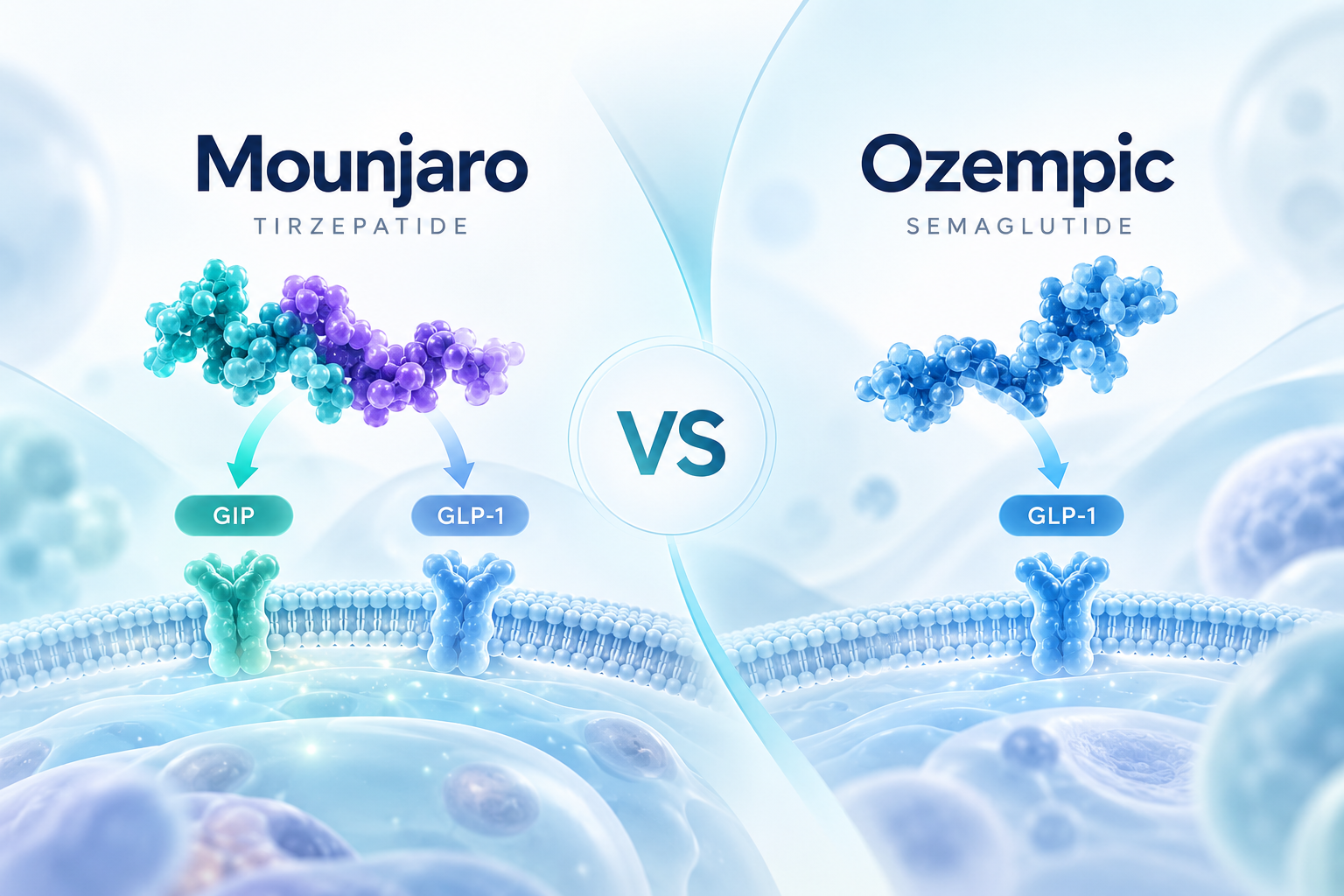
The main difference between Mounjaro and Ozempic is their active ingredient and receptor activity. Mounjaro contains tirzepatide, a dual GIP and GLP-1 receptor agonist, while Ozempic contains semaglutide, a GLP-1 receptor agonist. Both are once-weekly prescription injections used for type 2 diabetes, but they differ in how they work and in their clinical results.
Tirzepatide · Dual GIP / GLP-1 receptor agonist
Semaglutide · GLP-1 receptor agonist
| Feature | Mounjaro | Ozempic |
|---|---|---|
| Active ingredient | Tirzepatide | Semaglutide |
| Drug class | Dual GIP / GLP-1 receptor agonist | GLP-1 receptor agonist |
| Receptor targets | GIP and GLP-1 receptors | GLP-1 receptor |
| Administration | Once-weekly subcutaneous injection | Once-weekly subcutaneous injection |
| Primary use | Type 2 diabetes | Type 2 diabetes |
| Weight loss | Weight reduction commonly occurs during treatment; head-to-head evidence has shown greater average reductions than semaglutide 1 mg in the trial studied | Weight reduction commonly occurs during treatment |
| Blood sugar | Improves glycemic control; greater average A1C reductions than semaglutide 1 mg were observed in a head-to-head trial | Improves glycemic control |
| Dosing schedule | Once weekly | Once weekly |
| Common side effects | Gastrointestinal effects such as nausea, diarrhea, decreased appetite, vomiting and constipation | Gastrointestinal effects such as nausea, vomiting, diarrhea, abdominal pain and constipation |
| Cost | Varies by insurance and coverage | Varies by insurance and coverage |
Understanding how Mounjaro vs Ozempic work helps explain one of the most important differences between them. Mounjaro contains tirzepatide, which activates both GIP and GLP-1 receptors, while Ozempic contains semaglutide and primarily targets the GLP-1 receptor. Both act on incretin pathways involved in blood sugar regulation and appetite.
Mounjaro contains tirzepatide, which activates both the GIP and GLP-1 receptors. These incretin pathways influence glucose-dependent insulin secretion, glucagon levels, food intake and appetite. Its dual-receptor activity is the main mechanism that distinguishes Mounjaro from Ozempic.
Ozempic contains semaglutide, a GLP-1 receptor agonist. It activates the GLP-1 receptor pathway, influencing glucose-dependent insulin secretion, glucagon secretion, gastric emptying and appetite. Unlike Mounjaro, it does not directly activate the GIP receptor.
Weight change is one of the biggest questions in a Mounjaro vs Ozempic comparison. Mounjaro contains tirzepatide, while Ozempic contains semaglutide. Both treatments have been associated with weight reduction in people with type 2 diabetes, but direct clinical evidence has shown larger average reductions with tirzepatide than with the semaglutide dose studied.
In SURPASS-2, average body-weight reductions were 7.6 kg, 9.3 kg and 11.2 kg across the three tirzepatide groups studied. Tirzepatide produced greater average weight reductions than semaglutide 1 mg at each comparison studied.
Participants assigned to semaglutide 1 mg had an average body-weight reduction of 5.7 kg at 40 weeks. Semaglutide therefore produced meaningful weight reduction, although the average reduction was smaller than with the tirzepatide groups in this trial.
These numbers come from a specific head-to-head study in adults with type 2 diabetes and compared tirzepatide with semaglutide 1 mg. They should not be interpreted as guaranteed individual results or as a comparison of every available dose or indication.
So, is Mounjaro better than Ozempic for weight loss? In the SURPASS-2 head-to-head trial, tirzepatide produced greater average weight reductions than semaglutide 1 mg at the doses studied. However, that result does not mean Mounjaro is automatically the better treatment for every person. The appropriate option depends on the treatment indication, medical history, tolerability, coverage and clinician guidance.
When comparing Mounjaro vs Ozempic side effects, the two medications have considerable overlap. Gastrointestinal reactions are among the most commonly reported with both treatments. However, Mounjaro contains tirzepatide and targets both GIP and GLP-1 receptors, while Ozempic contains semaglutide and targets the GLP-1 receptor. Their safety profiles therefore overlap but are not identical.
Mounjaro and Ozempic are prescription medications with important contraindications, warnings and precautions in their prescribing information. Both carry boxed warnings related to thyroid C-cell tumors observed in animal studies and should not be used in people with certain relevant personal or family medical histories. Other important safety considerations differ by product and individual circumstances. Official prescribing information and guidance from a qualified healthcare professional should be used when evaluating either treatment.
Overall, the difference between Mounjaro and Ozempic is not simply which medication has fewer side effects. Both commonly cause gastrointestinal reactions, but the frequency and type of adverse reactions can differ. Tolerability, medical history and the specific safety information for each medication are important when comparing the two treatments.
Mounjaro and Ozempic are both administered as once-weekly subcutaneous injections, but they contain different active ingredients and follow product-specific dosing schedules. Mounjaro contains tirzepatide, while Ozempic contains semaglutide. Their doses are therefore not directly interchangeable.
Tirzepatide · once weekly
Semaglutide · once weekly
Although Mounjaro and Ozempic are both once-weekly injections, their doses should not be treated as equivalent or interchangeable. They contain different active ingredients and have their own prescribing schedules. Any treatment or dosing change should be based on the prescribing information for the specific medication and guidance from a qualified healthcare professional.
In a Mounjaro vs Ozempic cost comparison, the amount a patient pays can vary significantly. Both are prescription medications, and out-of-pocket costs depend on insurance coverage, pharmacy pricing, the prescribed indication and eligibility for manufacturer savings programs.
Tirzepatide
Semaglutide
When comparing Mounjaro vs Ozempic, current pricing and coverage should be checked for each medication. Insurance formularies, pharmacy prices and savings programs can change, and list price is not necessarily the amount an individual patient will pay.
The main difference between Mounjaro and Ozempic is their active ingredient and receptor activity. Mounjaro contains tirzepatide, which activates both GIP and GLP-1 receptors, while Ozempic contains semaglutide, a GLP-1 receptor agonist. Head-to-head evidence in adults with type 2 diabetes has shown greater average A1C and body-weight reductions with tirzepatide than with semaglutide 1 mg in the trial studied, but the most appropriate treatment depends on the individual clinical situation.
Mounjaro and Ozempic are prescription medications. Treatment choice depends on factors such as the approved indication, health history, treatment goals, tolerability, insurance coverage and guidance from a healthcare professional.
These Mounjaro vs Ozempic FAQs answer frequently searched questions about weight loss, GLP-1 activity and whether Mounjaro and Ozempic are the same medication.
In a head-to-head trial involving adults with type 2 diabetes, tirzepatide, the active ingredient in Mounjaro, produced greater average body-weight reductions than semaglutide 1 mg, the active ingredient in Ozempic, at the doses studied. This does not mean Mounjaro is better for every person, since treatment choice also depends on the indication, medical history, tolerability and other individual clinical factors.
Mounjaro is not semaglutide. Mounjaro contains tirzepatide, which activates both GIP and GLP-1 receptors and is therefore described as a dual GIP/GLP-1 receptor agonist. Semaglutide is a different active ingredient and is the medication contained in Ozempic.
No. Mounjaro and Ozempic are not the same medication. Mounjaro contains tirzepatide and targets both GIP and GLP-1 receptors, while Ozempic contains semaglutide and acts through the GLP-1 receptor. Both are once-weekly prescription injections, but they have different active ingredients and pharmacological profiles.
This FAQ provides general educational information and does not replace current product labeling or guidance from a qualified healthcare professional.
This Mounjaro vs Ozempic comparison is based on clinical research and medically reviewed resources covering tirzepatide, semaglutide, treatment differences, weight-loss outcomes, side effects and other key comparison points.
GLP Versus provides general educational information only. The content on this page is not medical advice and should not be used to diagnose, treat or prevent a medical condition, or as a substitute for advice from a qualified healthcare professional.